Showing posts with label waldorf grade 5. Show all posts

Thursday, August 30, 2018

Math through Literature

 Despite being an avid reader and history buff, I actually did not mind math until my Pre-Calculus class in high school.  That class about killed me.  Literally.  I crashed my car through the school parking lot getting to a 6 am tutoring session for extra help. Up until that point I loved seeing the pattern in numbers and really had fun with math.  Something about the absoluteness of mathematical rules, the utter lack of gray area, really appealed to me.

 I'm well aware that it can be tough to see the beauty in numbers when faced with intimidating pages of equations.  This is a collection of books that will really help you enjoy math. Seriously.

 The following books cover a wide range of audiences, so I'll do my best to suggest when they may be most helpful.


1 is One by Tasha Tudor
 Oh, we love this one so much, and it's not just the gorgeous illustrations.  "1 is one duckling swimming in a dish.  2 is two sisters making a wish."  It's hard to imagine a more lovely way to introduce a little one to their numbers. Bonus - this book goes up to 20.


Anno's Counting Book by Mitsumasa Anno
We are huge fans of Anno in our home and this book is perfect for the younger set.  The first page has  nothing on it - a barren winter landscape.  This is zero. Then we see one tree, one house, one bird, etc. As we move throughout the year each page has more sets to count.  That's what my son loved about it compared to other counting books.  Of course, I also love the simple, clean pictures that are the trademark style of Anno.


 I warned you of our love of Anno.  This one is so much fun.  The preface encourages you to gather some gems or pebbles in two colors to keep track of the ten little boys and girls that move from one house to the other.  The cutout windows make it even more fun!  Thoroughly engaging and imaginative.  And a great way for little mathematicians to learn the properties of ten.


Countablock by Christopher Franceshelli
 We like all of the books in this block book series (especially the Dinoblock), but this is the one I wish I had when my older boys were learning to count to 100.  It's fun and engaging.  The pictures are so modern and graphic compared to the ones above, which is a fun visual change, too.


One Hundred Angry Ants by Elinor J. Pinczes
100 hungry ants are traveling single file to a picnic when the littlest one notices that it's taking entirely too long to reach their destination.  He suggests two lines of 50, then 4 lines of 25 and so on.  This is a fun little tale to teach about grouping for the younger set.


Math-terpieces by Greg Tang
Greg Tang has a great series of books that help build math mastery by teaching a variety of math skills, like grouping, adding to an easier number in order to subtract, and finding patterns.  His books are great fun and we can always find a few at our library.


 This is another great series that is easy to come by at our library and suits a wide range of elementary students.  This particular volume is invaluable for gaining a concrete understanding of place value. When we started 5th grade geometry we revisited Sir Cumference and the first Round Table because it is such an easy way to remember the vocabulary of circles (Thank you, Lady Di of Ameter and Radius).  The Dragon of Pi was also wonderful for this age.  You can find a volume in this series to help make most any math concept come alive!


Demi is another household favorite around here and this one does not disappoint, in fact, it may be our very favorite of the list.  A greedy rajah has hoarded all of the rice while his subjects are starving. A clever girls outwits him by taking her reward as one grain of rice that doubles each day for thirty days.  The rajah quickly goes from laughing to scratching his head as the amount of rice she receives each day is carried out of the palace.  Here are a few pictures of Will figuring out how many grains she received by the end of the month.  He was smiling at her cleverness and his astonishment of how big the number grew!


This is great fun to keep track of the growing number, and will definitely require a pencil and paper as the number quickly grows.  This book teaches !, or factorials.  1 island has 2 countries which each have 3 mountains which each have 4 walled kingdoms.... We used this book last year once my third grader learned his multiplication tables and it was great fun for us all. The fifth grader got in on the action as well.  I won't list any more Anno math books, but we also love Anno's Magic Seeds, which, of course, grow exponentially.


String, Straight-Edge, & Shadow by Julia E. Diggins
  We came across this book last year while my son was studying Ancient Egypt as a block in Waldorf Grade 5.  This book does indeed explain how the rope stretchers of Ancient Egypt found a way to make perfect right triangles but it starts with even more fundamental geometry.  The first two chapters beautifully describe the patterns and numbers found in nature and man's special sensitivity to recognizing them.  Diggins tells wonderful stories in this book, such as how she guesses that early man figured out how to draw a perfect circle by watching a beast of burden tied to a stake walk around and wear a path into the ground.  This is a book we definitely have on hand for older elementary grades to go with Ancient Mesopotamian, Egyptian and Greek studies, and even beyond,  but I think the early chapters are a beautiful read aloud for younger elementary age children. 

BONUS:

The Boy Who Loved Math by Deborah Heiligman
 I listed this as a bonus because it doesn't really fit the same category as the other books.  It doesn't teach a practical math strategy or encourage you to work out a problem.  It does provide a very engaging and inspiring story about an amazing mathematician!  We went through a period when my middle son was about 4-5 years old where he requested this book constantly.  It's definitely worth a read for older elementary kids too.

  These are our ten favorites, so far!  I'm sure there are many more that we should be using.  I'd love it if you share your families' favorites in the comments.

Monday, March 12, 2018

Waldorf Grade 5: Ancient Cultures Block

  Our second block of the fifth grade school year was Ancient Cultures, which combined language arts, history, social studies and geography.  As an aside, anytime we are not in a math block we always start our day with some math practice on the board, so that those skills do not get forgotten.

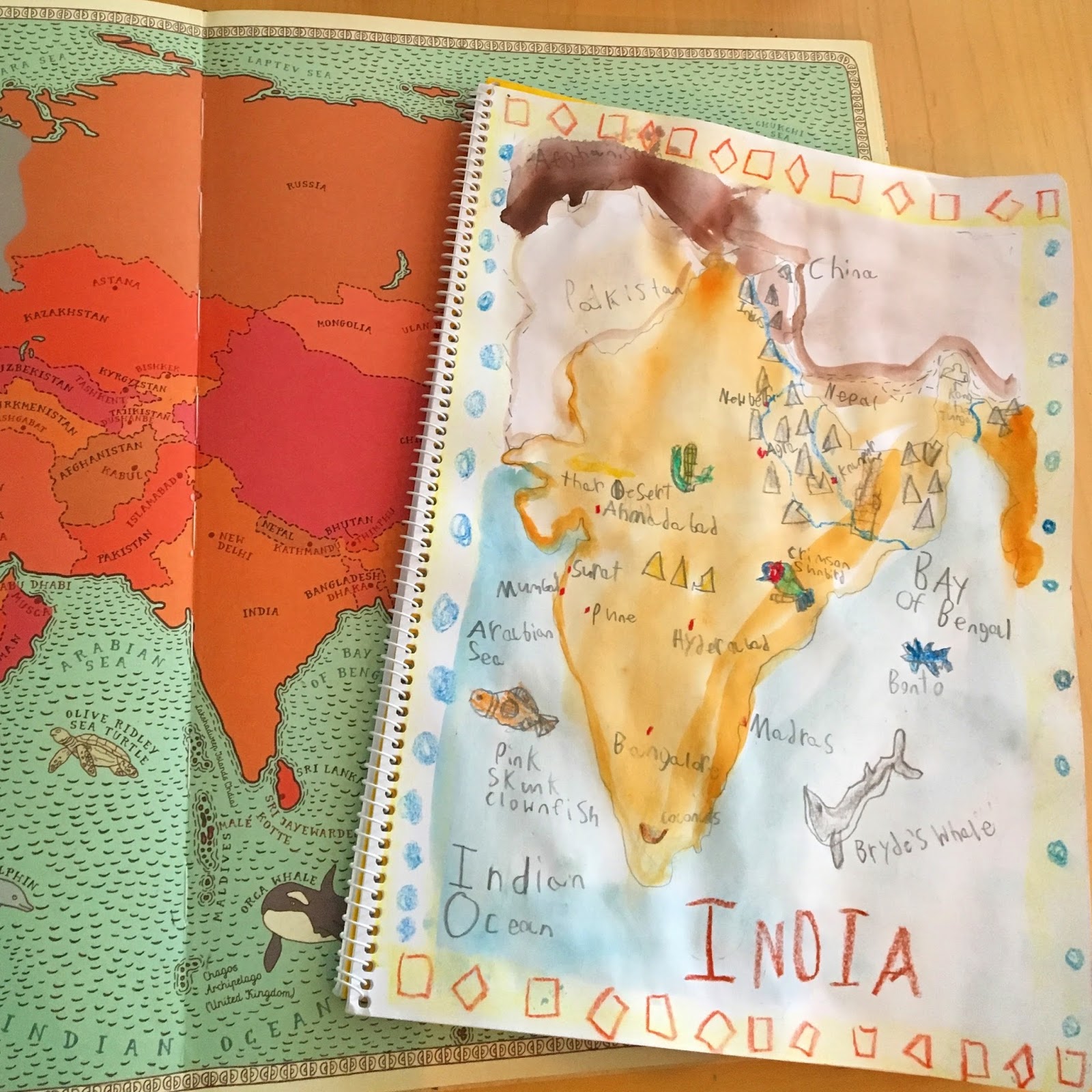
  Our first area of focus was India and it covered two weeks. As usual, we began by mapping India and studying the indigenous plants and animals.


 We learned the origin story Manu and the Flood.  We found references to Atlantis and compared it to Noah's ark.  For any of the myths or history stories, we follow a two day schedule of learning.  On the first day I tell the story, usually with a chalk drawing I have prepared, and Jack will make a main lesson page drawing.  On the following day he will retell the story, in his own words, while we work on language mechanics.  Some days he just writes, but if it is a complicated story I may help him make an outline first to make sure we don't leave out any crucial information.  


 We found a beautiful version of the Ramayana in the book A Year Full of Stories.  We really enjoyed learning about the faith of India through the Bhagavad-Gita and comparing it to our own values.

\

 Since the boys are in the school room together, they often hear parts of their brother's main lessons. Will was halfway paying attention to the story of Rama and Sita when he heard mention of the Monkey King, Hanuman.  I guess the idea of a Monkey King proved irresistible to Will and he immediately had to drop his own project and get his vision on paper! This is one of my favorite things about homeschooling: that we have the space for this kind of work.


 Our third week of study focused on Buddha.  Again, we compared our own values and faith with The Eightfold Path and the Noble Truths.


  For our final week of study, we spent the first day mapping Persia.


  The following day we covered Zarathustra.  Again, this was a great opportunity to compare and contrast all of these world religions with our own.  How wonderful to see so many core values in common.  


  Later in the week we looked at Xerxes and the wars with Greece.  Jack is excited to get to the Ancient Greece block (thanks, Percy Jackson!), so he was eager to hear mention of Sparta.  We may have taken more of a Greek focus than was intended, but it's nice to have the student so eager!


Waldorf Grade 5: Geography Mini Units

  The first block for Waldorf Essentials Fifth grade combines mapping, geography and history.  We started with a review of US Geography, learning which states were in each of the four regions and remembering capitals.  This took us through the first week of school, studying a new region each day. For each region Jack made a main lesson page that listed each of the states and their capitals.  We worked with some map puzzles and even played the Stack the States app on the iPhone (the horror! So very un-Waldorf!  Yet, so very effective in this instance!).


   We studied Africa for the next week, mapping the continent and reading about the flora and fauna.  


 If you have ever used Waldorf Essentials before, you will know that the curriculum can often be a suggestion about what to focus on for the daily lesson.  Personally, I love having this framework and tailoring the lessons to fit the child.  It does mean you will need some extra resources, many are suggested by Melisa (especially in the grade overview audio recordings on her site).  The extra resources we use are normally wikipedia pages printed out, examples of main lessons found on pinterest and library books.  We have managed to build a pretty good home library over the years and I was able to pull several books to help with these units.  Here are the bulk of them:


 The Monkey and the Fiddle was our choice for the folk tale. Jack did a great job on his first summary of the year and took great care with his border and drawing.  We try to follow a two day Waldorf approach to Main Lessons,  listening to the story on the first day and then modeling or drawing from it.  On the second day, after the story has had time to digest, we write a summary.  We usually discuss it first, to make sure that we remember the important characters and events.  I will put proper names on the board to help with spelling, but Jack writes it himself.  When he is finished, we read through it together to catch spelling or grammatical errors.  I'm a big fan of focusing on a few items at a time, as I gleaned from Julie at Brave Writer.  For example, we may discuss the following: run-on sentences, proper nouns start with a capital letter, and sentences end with a punctuation mark. I'll have Jack look for those items on his own and try to limit any critiques to those specific areas.


  To wrap up the Africa block, Jack cooked an African feast for us, using this Moroccan Chickpea Stew recipe. 


  Our next mini block was Atlantis.  This definitely seems like an odd choice, but it is typical in the Waldorf fifth grade curriculum.  We talked about the legends, specifically Plato's writings about it, and where it may have been located. We also looked at maps drawn from Plato's description and made a clay model.  Like the other areas of study, we also looked at animals and plants.


  Our next stop on the mini world tour was Australia.  Aboriginal folk tales combined with exotic plants and animals mad this a really enjoyable unit to study. I am so glad we found out about the book Topsy-Turvy World: How Australian Animals Puzzled Early Explorers by Kristy Murray from some Australian homeschoolers on IG.  Reading about the European explorers' first impressions of animals such as the platypus and wombat was highly entertaining.  He chose to write about the kangaroo from the fifteen species highlighted in this book.


  Our geography block really set the stage for a fun school year.  We got a little busy and didn't plan a meal for Australia, which was a shame.  It certainly adds a lot to the unit and Jack is so proud to take charge of a family dinner.  Jack's map making skills improved greatly this month, as did his world geography knowledge.